Posts

Showing posts with the label Copenhagen

Infrastructure Scavenger Hunt (Copenhagen)
Image
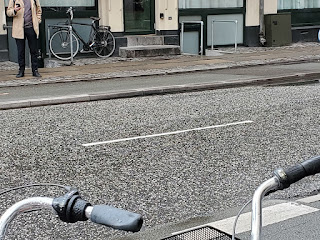
On the last day in Copenhagen, we were tasked with another scavenger hunt. This time, we searched for particular types of bicycle supportive infrastructure. The most visible examples include the curb assists that allow bicyclists to transition from the road into a cycle track. And of course, the cycle track itself. A protected cycle track in Copenhagen Elements of many intersections in Copenhagen include designating where the bicycle lane continues after the cycle track transitions into the intersection. Naturally, the road must remain accessible for cars to travel through, so the cycle track segment must end when one enters an intersection. So, blue paint identifies for both bicyclists and drivers where the bike lane continues through the intersection, giving bicyclists certainty in where to be and drivers certainty of where the biking traffic will be, especially those making a left or right turn through the intersection. As I noted from the previous blog post, earlier in the day duri...

Arriving in Copenhagen

I enrolled in this study abroad course to experience how biking for transport can work when provided with supportive infrastructure. Moreso though is to understand how culture translates into the political will required to advance projects that make design concepts into reality. The United States remains an automobile-dominated transportation system. Traffic plagues nearly all major cities and metropolitan areas. The consequences of lost time spent in traffic, the personal effects of sedentary lifestyles and externalities such as social exclusion, and the environmental impact of gasoline use and emissions are well understood. The predominant response to the consequences of an automobile-dominated system is “green” the vehicle fleet. Essentially, “how can we keep what we have, but not pollute the environment at the same time”? Nevertheless, such solutions do not address the disparities in car ownership between different populations. For example, electric vehicles are more expensive comp...